How Do Algal Blooms Turn Into Environmental Crises?
An algal bloom develops when microscopic algae accumulate in water in unusually large amounts. Off the state of South Australia, a bloom along the southern coast has lasted for over a year and has been linked to widespread marine…
An algal bloom develops when microscopic algae accumulate in water in unusually large amounts. Off the state of South Australia, a bloom along the southern coast has lasted for over a year and has been linked to widespread marine animal deaths. [1][2] Floodwaters, nutrients brought up from deeper water and changing ocean conditions may all have contributed to its development. [3]
What Are Algal Blooms and Eutrophication?
Algae use sunlight to grow and provide food for other aquatic organisms. Like plants on land, they require nutrients including nitrogen and phosphorus, but an excess of these nutrients can support unusually abundant growth. [4] This enrichment and the increased growth of algae and plants are known as eutrophication. An algal bloom can be one visible result. [5]
Dense algal growth can block sunlight from reaching plants below the surface, limiting their growth and sometimes causing them to die. This reduces the habitat available to fish and other animals. [4][5][6] As dead algae and plants decompose, bacteria use up oxygen that aquatic animals also need. Fish may be able to move to water with more oxygen, while less mobile animals can suffocate. [5] The effects can continue after the bloom itself begins to disappear.
Some blooms produce toxins that harm aquatic animals and threaten human health. [7][6] A harmful algal bloom is one that causes ecological damage or a health risk, whether from toxins, dense growth, or both. Even a bloom without toxins can kill aquatic life. Where toxins are present, small fish and shellfish can ingest them and pass them to larger animals that feed on them. [6]
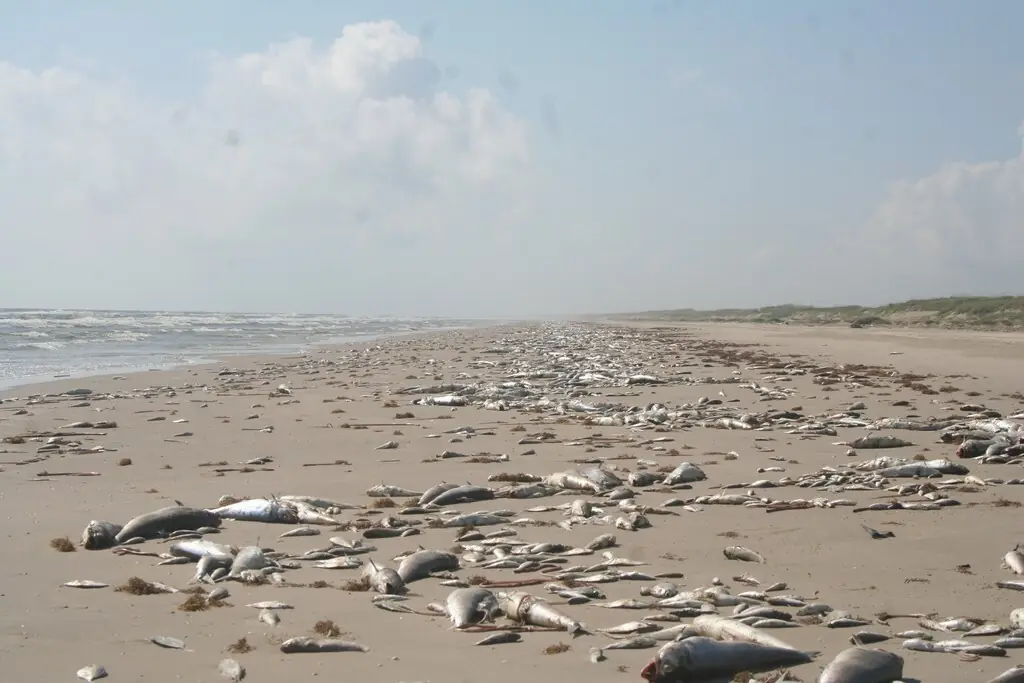 A past harmful algal bloom left dead fish along Padre Island National Seashore, Texas.
Photo: National Park Service.
A past harmful algal bloom left dead fish along Padre Island National Seashore, Texas.
Photo: National Park Service.
.jpg)
What Causes An Algal Bloom to Form?
Rainwater moving from land into streams can carry nutrients with it. On farmland, fertilizer and manure left unused by crops may wash away, with nitrogen and phosphorus travelling in eroded soil or dissolved in water moving over and through the ground. Field drains provide another route. [8] Once the nutrients reach a lake, they can support growth well beyond the field of origin. Wastewater treatment that removes too little nitrogen and phosphorus, and poorly maintained septic systems, can add further supplies. [9]
The ocean can supply nutrients to coastal waters too. Upwelling occurs when currents bring deeper, nutrient-rich water toward the surface, and it may have contributed to the South Australian bloom. [3] Identifying the source is necessary because natural ocean circulation, agricultural runoff and wastewater require different responses.
Nutrients make growth possible, while light, temperature and water movement influence how much algae can grow. Slow water gives them longer to multiply before being carried away. [10] Heavy rain may deliver nutrients, followed by a dry period with less movement and replacement of the water. Climate change can add to these conditions through warming and altered rainfall patterns. [11] A wet period followed by warmth and still water can therefore be more favourable for a bloom than warmth alone.
Wind can push algae toward a shore and concentrate part of a larger bloom beside a beach. [12] The colour and size of that patch cannot reliably establish its toxicity, since growth and toxin concentrations may reach their peaks at different times. [10]
Water layers can also limit the oxygen available below a bloom. Warm water may remain above cooler water, and freshwater can sit above denser saltwater. This layering, called stratification, reduces the mixing that carries oxygen-rich surface water downward. [11] Decomposition below the surface then consumes oxygen that is harder to replace, while warm water holds less oxygen to begin with. [13] If replenishment cannot keep up, the deeper water becomes hypoxic, meaning it has too little oxygen for many aquatic animals. [5] Conditions near the bottom may continue deteriorating even when the visible bloom fades.
What Happened in Recent Events?
In South Australia, laboratory tests have confirmed toxin production by an algal species found in the bloom. [1] A preliminary assessment by the South Australian Research and Development Institute points to River Murray floodwaters and unusually strong upwelling as potential nutrient inputs before the outbreak. Calm conditions and a marine heatwave, or unusually warm seawater, may then have helped the water separate into layers and retain the algae. [14] The contribution of each factor remains unresolved. Warmth may have mattered through its effects on water movement rather than directly accelerating the growth of the toxin-producing species, which favours relatively cool conditions in preliminary laboratory tests. [14]
River-delivered nutrient pollution plays a clearer role in Lake Erie, one of North America's Great Lakes, shared by the United States and Canada. Its recurring summer blooms affect a lake that supplies drinking water to communities around its shores. [15] In the western lake, the Maumee River delivers phosphorus that feeds the growth, and NOAA, the US ocean and atmosphere agency, uses measurements of that supply to help forecast bloom size. [16] An earlier study of an exceptionally large bloom found that agricultural nutrient losses, heavy rain and lake circulation had combined to support the outbreak. [17]
Last summer, NOAA rated Lake Erie’s bloom as mild because it contained less algal material than the previous summer’s, although it lasted into autumn. [18] This rating measures growth rather than toxins, so a smaller bloom is not automatically safer. One mild season also cannot establish that excess nutrient inputs have been resolved.
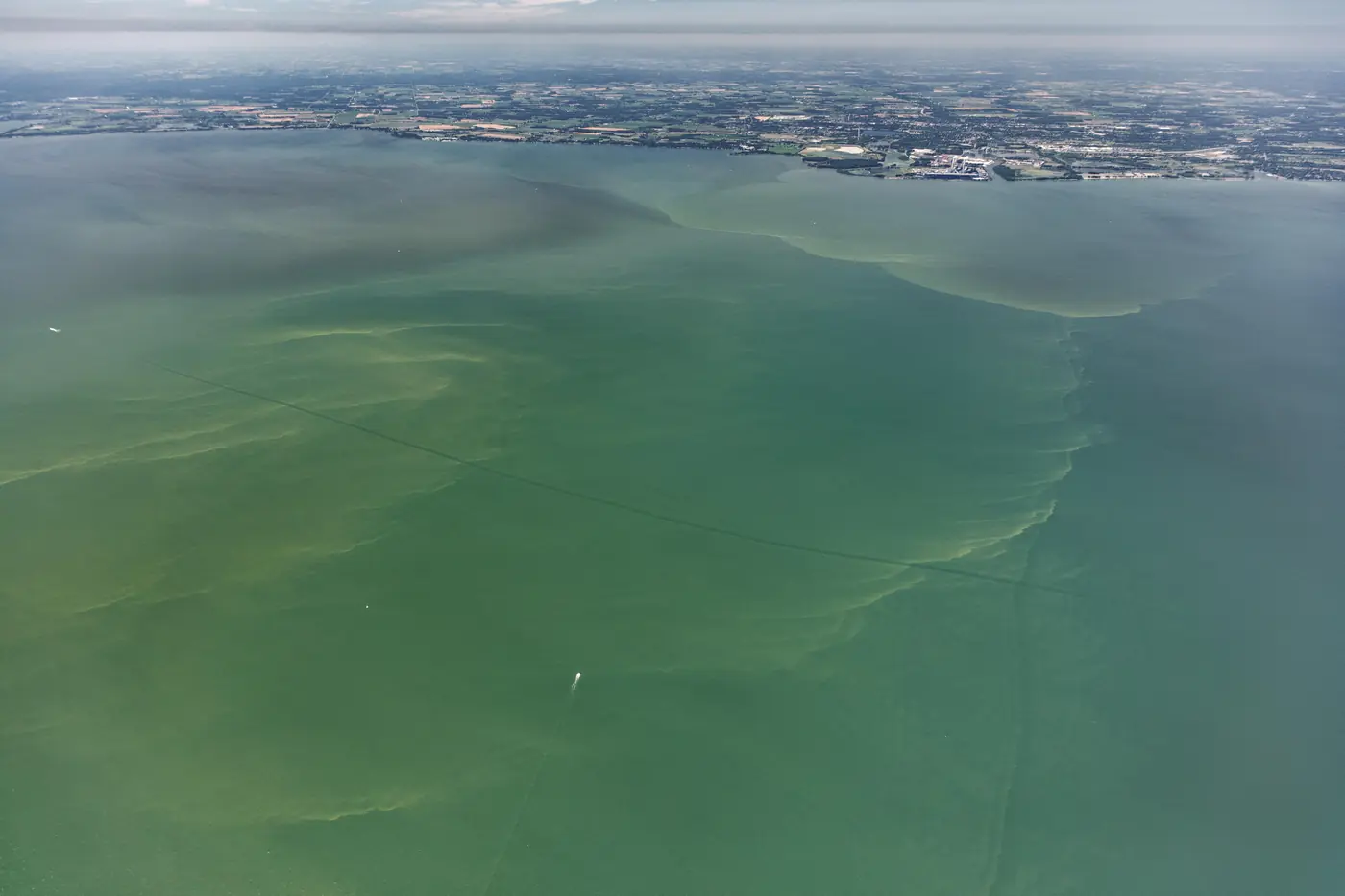 An aerial view of western Lake Erie during an earlier algal bloom.
Photo: Aerial Associates Photography, Inc. / Zachary Haslick, via NOAA GLERL.
An aerial view of western Lake Erie during an earlier algal bloom.
Photo: Aerial Associates Photography, Inc. / Zachary Haslick, via NOAA GLERL.
.jpg)
In the northern Gulf of Mexico, nutrients from the Mississippi and Atchafalaya rivers support growth whose decomposition contributes to a seasonal low-oxygen area, often called a dead zone. [19] Algae growing near the surface can therefore affect animals on the seabed as the material sinks and breaks down, leaving too little oxygen below.
Before this summer's survey, NOAA forecast roughly 7,000 square miles of low-oxygen water, based on river measurements and an assumption of typical summer weather. [19] The survey found about 1,300 square miles. Tropical Storm Bertha had passed shortly before the research cruise, and its winds and waves mixed oxygen-rich surface water downwards. NOAA attributes the unexpectedly small area to that disturbance. [20] The storm temporarily improved the oxygen supply, but it did not demonstrate a reduction in the nutrients arriving from upstream. Like a mild bloom season in Erie, a smaller dead zone needs to be interpreted alongside the conditions that produced it.
Lough Neagh, a large freshwater lake in Northern Ireland, shows why that underlying nutrient supply matters across many seasons. Repeated blooms have collected around jetties and marinas, restricting recreation and affecting local businesses. Samples from a major outbreak contained high phosphorus levels and toxin-producing organisms. [21] Agriculture and wastewater are the lake's main phosphorus sources, and nutrients have built up over decades. Warmer water and exceptionally heavy summer rain have added pressure, including by washing more phosphorus into the lake. [22]
Monitoring after the major outbreak recorded another bloom at a lakeshore swimming area, where advice against swimming continued for the rest of the season. [23] The return of growth shows why a clear surface does not necessarily mean recovery. If excess nutrients remain available, another bloom can develop when conditions are favourable.
How Can We Prevent Harmful Algal Blooms?
For waters affected by nutrient pollution, reducing the excess supply can help prevent recurring blooms. Matching fertilizer and manure to crop needs leaves less to wash away, while keeping soil covered between harvests helps retain nutrients. Vegetation beside fields and waterways can intercept some runoff. [8] The measures need to match the routes nutrients take, however. Water travelling through a drainage pipe may bypass a grass strip entirely, leaving drainage losses to be addressed separately.
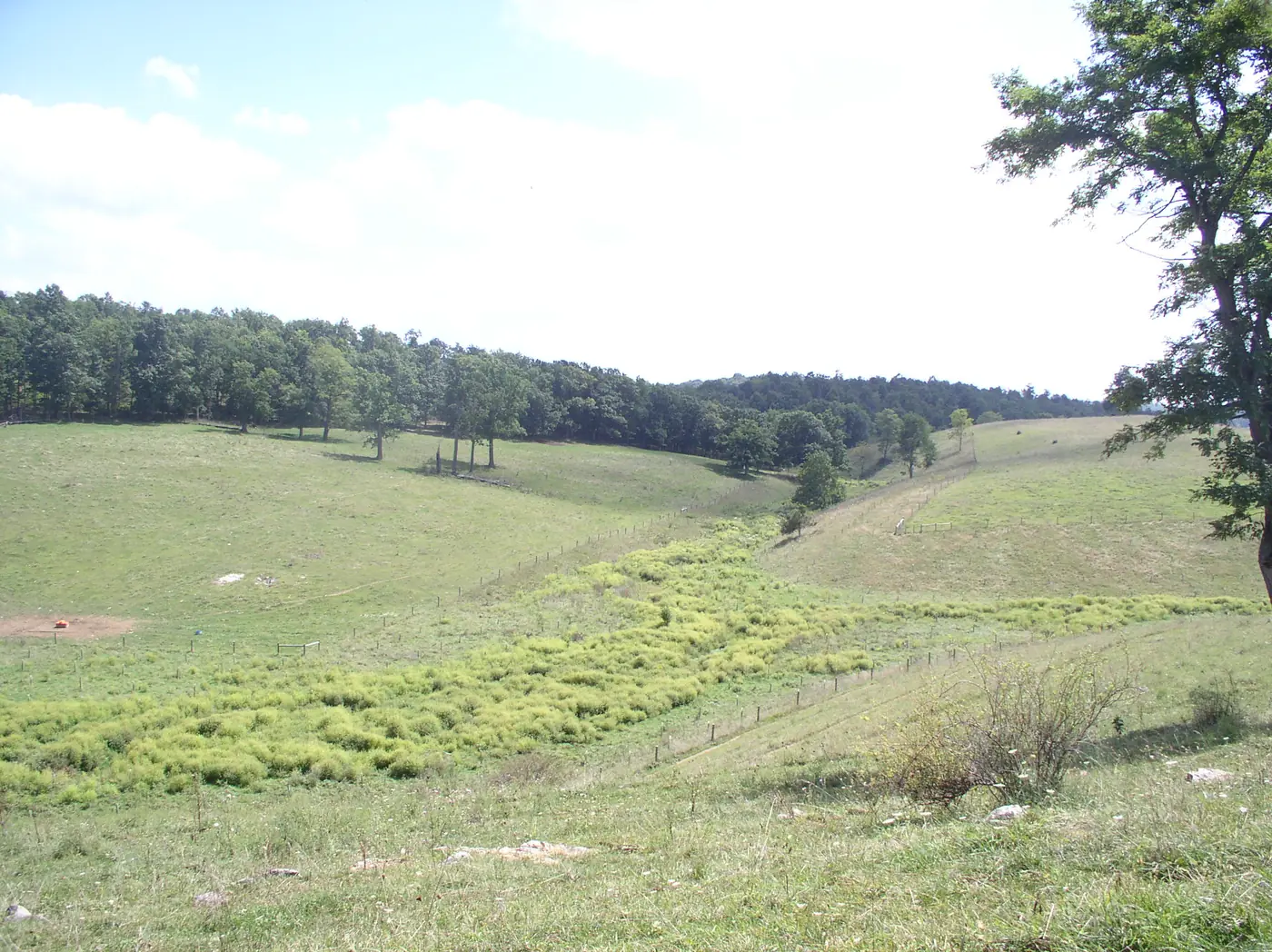 A vegetated buffer on farmland in Augusta County, Virginia, illustrates one way to protect waterways from runoff.
Photo: USDA Farm Service Agency.
A vegetated buffer on farmland in Augusta County, Virginia, illustrates one way to protect waterways from runoff.
Photo: USDA Farm Service Agency.

Treatment plants can remove more nitrogen and phosphorus before discharging wastewater, while maintaining septic systems can limit additional losses. [9] Measurements from rivers and treatment-plant discharges can then show whether these changes are reducing the nutrient supply reaching the affected water.
Which nutrients are reduced also matters. In experiments with Lake Erie water, cutting nitrogen and phosphorus together controlled growth more effectively than cutting phosphorus alone. [24] The findings support addressing both nutrients, while continued lake monitoring is needed to establish how those reductions work outside the experiments.
Recovery may still take time after new inputs fall. Research in US rivers found that phosphorus left from earlier agricultural activity can continue contributing to pollution. [25] Tracking these older sources alongside present-day inputs helps determine whether recovery is slow because past nutrients remain or because ongoing losses still need attention.
While nutrient reductions take effect, monitoring can help communities respond to blooms. Satellite images and current forecasts track growth approaching swimming areas or water supplies, and samples identify harmful organisms and toxins. [12] Measurements of oxygen below the surface detect hazards that images cannot reveal. Together, these observations help manage exposure while longer-term measures address the conditions supporting growth.
For communities around Lake Erie and Lough Neagh, recovery means fewer harmful outbreaks and better conditions for aquatic life over successive seasons. That depends on how nutrient supply, growth and oxygen interact over time, beyond whether the water looks clear on a particular day.
Sources
Peer-reviewed investigation identifies potential causes of harmful algal bloom
NOAA First Early Season Projection Predicts a Mild to Moderate Bloom for Lake Erie in Summer 2025
NOAA forecasts an above-average summer “dead zone” in Gulf of America
NOAA, Partners Measure Smaller-than-Anticipated Hypoxic Zone in Gulf
Investigating the Likelihood of a Lough Neagh Bloom Scenario Happening in Ireland
Summary of Blue-Green Algae Monitoring in Northern Ireland Bathing Waters 2024
Variable impacts of contemporary versus legacy agricultural phosphorus on US river water quality