Post-Combustion Capture Part 2
Learn about the various CO2 storage methods including structural trapping, residual trapping, solubility trapping, and mineralization that keep captured carbon safely underground.
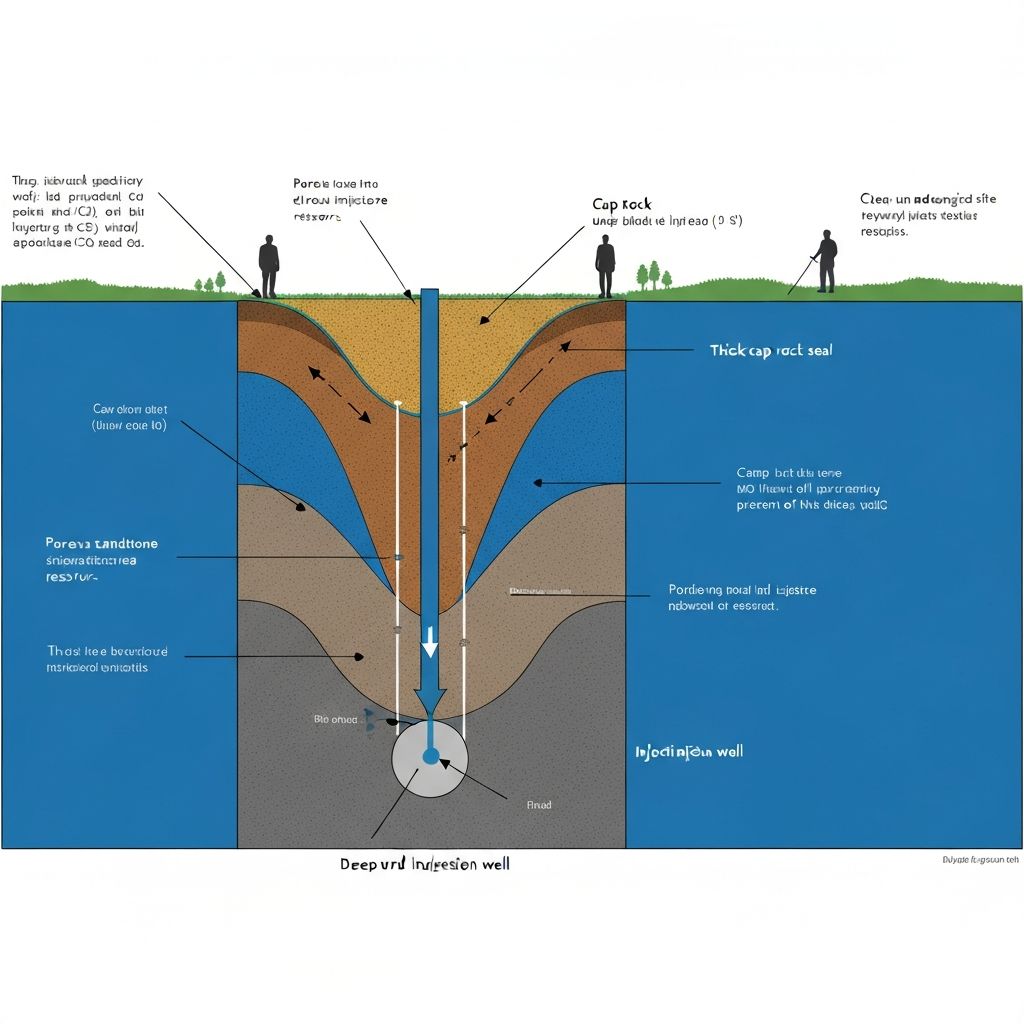
There are currently 40 commercial carbon capture facilities around the world, collectively capturing 45 megatons of carbon dioxide. Not only this, but we are expected to have 50 more carbon capture machines in operation by 2030. But, once the CO2 is separated in these large machines, where does it go from there? How is it stored? Keep reading to find out.
Structural trapping involves a physical barrier preventing CO2 from escaping. CO2 is injected into a porous reservoir rock such as sandstone or limestone. An impermeable cap rock in a layer on top of the porous rock acts as a seal, stopping CO2 from escaping into the atmosphere. Apt geological formations are critical for structural trapping to work.
Once CO2 is separated from atmospheric or flue gas, it can become supercritical CO2 under high pressure and temperatures. In residual trapping, supercritical CO2 is injected into the pore spaces of rocks. It then gets trapped in narrow passages between these pores and becomes immobile. This method is highly stable because the CO2 has no chance of escaping.
In solubility trapping, CO2 is dissolved in brine or salty water deep underground. The dissolved CO2 forms carbonic acid through chemical reactions. The result is a stable solution from which CO2 cannot escape. When choosing CO2 storage methods, it is vital to take into consideration that these chemical reactions can take decades and even centuries.
Over millions of years, dissolved CO2 can react with minerals in rocks such as silicates to form solid carbonates. One example is calcium carbonate. Once a solid carbite, the carbon dioxide cannot be released unless it undergoes a different chemical reaction.
CO2 is transported to the injection site via pipelines; however, there are some cases where ships and trucks are used for offshore storage areas. Engineers drill wells 1-3 km deep into geological formations (reservoirs, saline aquifers, depleted gas fields, basalt formations) under high pressure. For decades, the movement of CO2 has been tracked using seismic imaging, and surface gas measurements are taken for leak checks.