Wildfire Smoke Without Borders: From Canadian Forests to Distant Cities
On June 7, 2023, smoke obscured New York City's skyline and turned the sky orange. The fires responsible were burning in Canada. Smoke from Quebec had travelled south into the northeastern United States, reaching the air that…
On June 7, 2023, smoke obscured New York City's skyline and turned the sky orange. The fires responsible were burning in Canada. Smoke from Quebec had travelled south into the northeastern United States, reaching the air that millions of people were breathing. Canadian wildfire smoke had passed over the region before, often high enough to attract little attention. This time, it arrived close to the ground. [1]
The smoke disrupted activities across cities far from the fires. Outdoor events were cancelled, professional sports were postponed, and residents received air-quality warnings. New York, Philadelphia, Baltimore, and Washington, D.C., were all affected as smoke from distant forests reached their streets. [2]
A city does not have to be near a wildfire to prepare for its pollution. The route and height of the smoke determine which distant communities encounter it and whether it reaches the air people breathe.
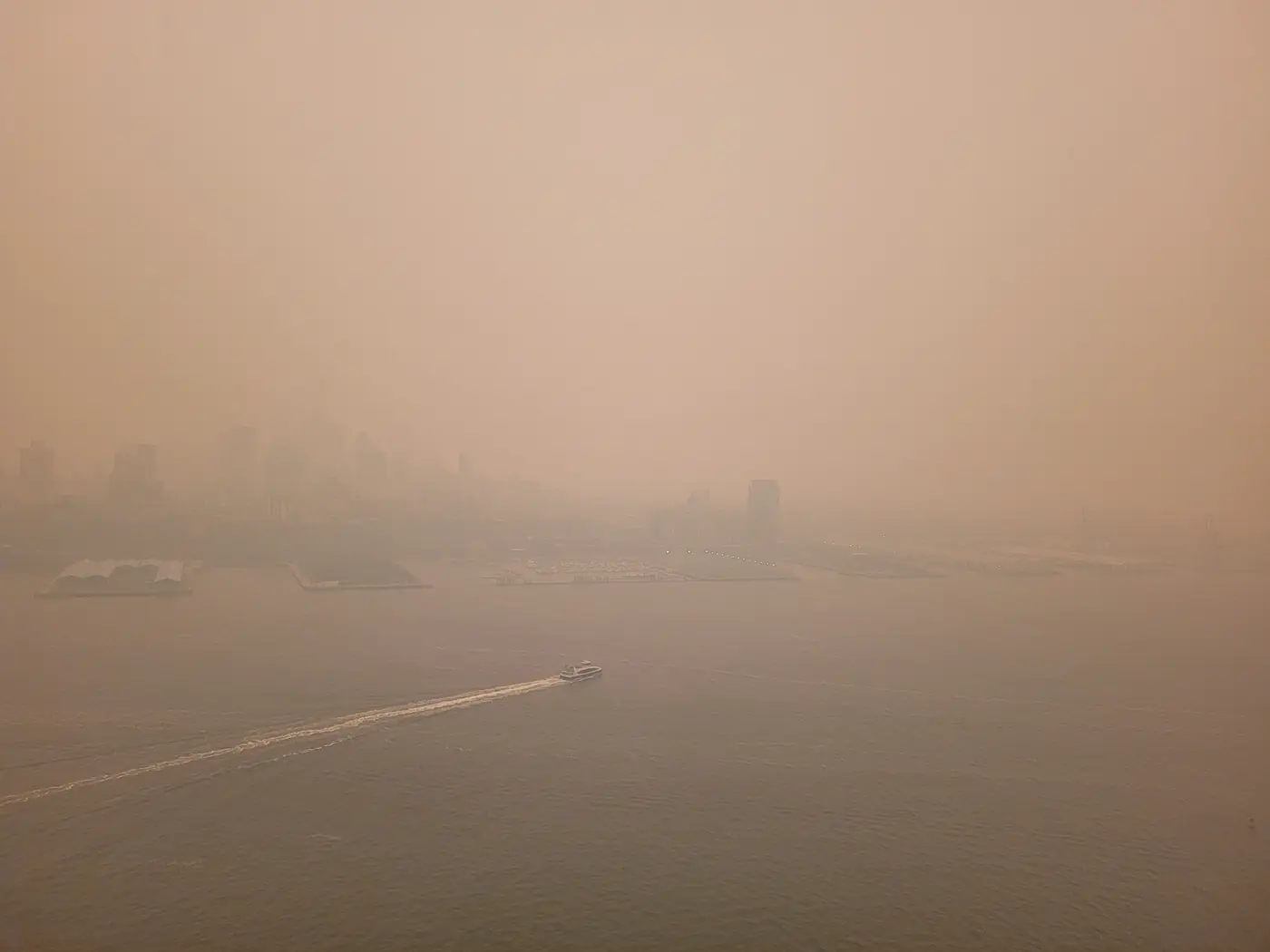 The East River and downtown Brooklyn, photographed from Lower Manhattan on June 7, 2023.
Credit: SnowFire / Wikimedia Commons, CC BY 4.0.
The East River and downtown Brooklyn, photographed from Lower Manhattan on June 7, 2023.
Credit: SnowFire / Wikimedia Commons, CC BY 4.0.

Canadian Forests and the Conditions Behind Extreme Fires
Canada's 2023 wildfire season extended from spring into autumn and affected much of the country's forested territory. An analysis in Nature Communications estimated that approximately 15 million hectares burned, more than twice the previous national record. More than 200 communities were evacuated. For people near the fires, smoke accompanied the immediate danger of losing homes and having to leave familiar places. [3]
Early snowmelt exposed the ground sooner, while prolonged drought in western Canada and rapid drying in parts of the east made conditions favourable for fire. After ignition, extended heat and low moisture allowed forests to keep burning. Exceptionally large fires spread across a broad area and contributed to the scale of the season. [3]
Weather influences fire partly by changing the moisture in vegetation and material on the forest floor. Dry fuels burn more readily, while strong winds can accelerate a fire's growth. Lightning or human activity provides an ignition; the surrounding conditions help determine what happens afterward. [3] A study comparing climate simulations with and without human influence found that human-caused climate change increased the likelihood of the exceptional area burned across most of Canada in 2023. It also made a fire season of that length more than five times as likely. [4]
Burning vegetation releases gases, tiny solid particles and liquid droplets, which form smoke together with water vapour. Fine particulate matter, called PM₂.₅, consists of particles no larger than 2.5 micrometres in diameter. Their small size allows them to be inhaled deep into the lungs. [5]
How Wildfire Smoke Crosses Borders
Hot air rises above a fire and carries smoke with it. How high it travels depends on the heat produced and the surrounding atmosphere. Forecasting models account for this upward movement because the height at which smoke enters the air affects where it goes afterward. [6]
Winds carry the smoke horizontally, while turbulence mixes it into a larger volume of air. Its concentration generally falls as it spreads, but it can reach a wider area. Strong winds may transport it far beyond the forest to communities that are not directly threatened by flames, with the route determined by weather around and above the fire. [7]
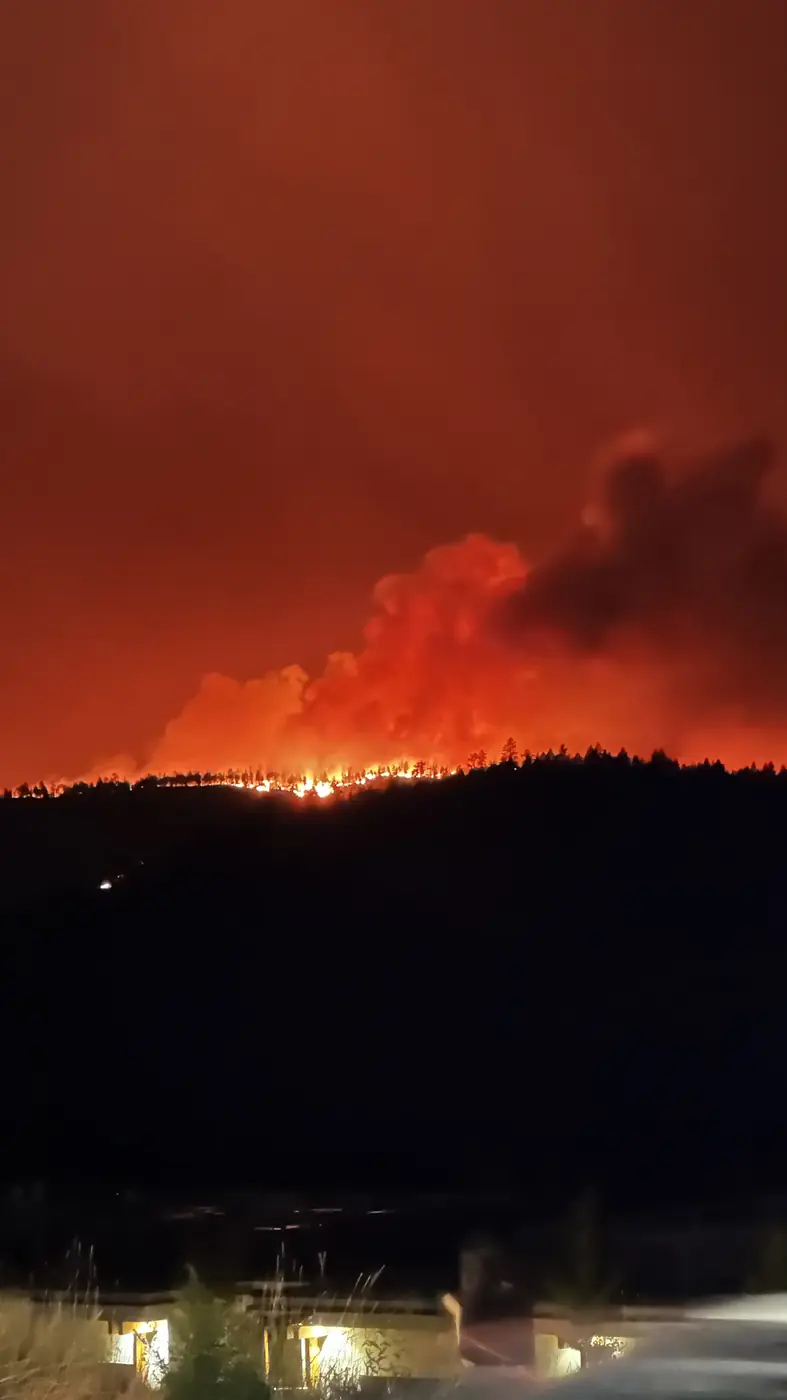 A wildfire near the University of British Columbia Okanagan on August 17, 2023, later in Canada's exceptional fire season.
Credit: TNdlovu2003 / Wikimedia Commons, CC BY-SA 4.0.
A wildfire near the University of British Columbia Okanagan on August 17, 2023, later in Canada's exceptional fire season.
Credit: TNdlovu2003 / Wikimedia Commons, CC BY-SA 4.0.

During the June episode, high pressure over central Canada and low pressure near Maine helped funnel smoke south into the northeastern United States. The weather pattern persisted, repeatedly directing polluted air into the region. Conditions began improving on the evening of June 9 as the episode eased. The location of the fires mattered, but the circulation around them determined which cities received the smoke. [2]
Smoke can also change chemically while travelling. Some gases react in sunlight and help form ground-level ozone downwind, although this depends on the chemical and weather conditions of the particular event. The distance travelled does not, by itself, tell us how clean the arriving air will be. [5]
From Smoke Overhead to Pollution at Street Level
A visible plume in a satellite image does not show how much pollution is at ground level, because smoke can move in several atmospheric layers. During June 2023, instruments near Greenbelt, Maryland, detected thick smoke rising from the surface along with separate, thinner layers much higher up. [1]
Vertical movement and mixing affect how much smoke reaches people below. In the lowest atmosphere, weak winds and limited mixing can allow pollution to build up. A temperature inversion, where cooler air sits beneath warmer air, suppresses upward movement and can make poor air quality last longer. The weather influences both where smoke arrives and how quickly it clears. [7]
The journey across the Atlantic illustrates why altitude matters. In late June 2023, the Copernicus Atmosphere Monitoring Service tracked a substantial plume travelling from Canada toward Europe. Much of that transport occurred high in the atmosphere, and the service did not expect that particular episode to significantly worsen surface air quality. Hazy skies and altered sunsets could still reveal its presence. [8]
That forecast concerned one episode, rather than the whole fire season. A later study using satellite observations, pollution estimates, and atmospheric modelling found that the Canadian fires in 2023 increased annual average exposure to fine particles in Europe as well as North America. [9] An elevated plume may have little effect at the surface on one day, while months of fires still change overall exposure. The effects vary between locations and over time.
Local measurements and forecasts are more useful for assessing exposure than the appearance of a distant plume. AirNow combines fire, smoke, and monitoring information so residents can check conditions near them within the wider event. [10]
Health Risks Far From the Flames
Exposure depends on the concentration of particles, the time spent breathing the air, and activity level. Exercise increases breathing, so a person may inhale more pollution during the same time outdoors. Fine particles reaching deep into the respiratory system can cause inflammation and other biological responses. [11]
Health Canada’s review found consistent associations between wildfire smoke and increased emergency visits, hospital admissions, and medication use for respiratory conditions, especially asthma and chronic obstructive pulmonary disease. Effects can appear on the day of exposure or over the following days. [12] Health services may therefore continue responding after the visible haze has cleared.
Longer exposure raises additional concerns. A study of approximately 22 million older U.S. adults linked higher average wildfire-smoke exposure over the preceding two years with an increased risk of developing heart failure. This was an observational association using estimated residential exposure, so it cannot predict an individual's outcome or establish the consequences of one smoky afternoon. It does, however, add evidence that the health burden extends beyond immediate breathing symptoms. [13]
People also differ in their vulnerability and ability to avoid exposure. Children, older adults, pregnant people, and those with existing heart or lung conditions can face greater risks. Outdoor workers may be unable to stay inside, while low incomes or insecure housing can limit access to protected indoor space. [14] The same warning can reach residents who have very different options for acting on it.
Preparing Distant Cities for Smoke
Air-quality guidance can be useful before smoke becomes visible. U.S. residents can follow AirNow’s Air Quality Index and local advisories, while Canadian residents can use the Air Quality Health Index and regional alerts. Updates matter because conditions may change within hours, affecting decisions about outdoor work, sport, and school activities. Pollution can still be present when smoke is difficult to see or smell. [10][14]
Indoors, protection depends on reducing the amount of smoke entering a building and removing particles already inside. The U.S. Environmental Protection Agency recommends creating a cleaner-air room with closed windows and doors and a portable air cleaner sized for the space. The cleaner should not produce ozone. Compatible, efficient filters in a building's ventilation system can also help, while avoiding candles, smoking, and other particle-producing activities prevents additional indoor pollution. [15]
Closing windows must be balanced against heat. A home that becomes dangerously hot is not a suitable refuge. Health Canada advises prioritising keeping cool during combined heat and smoke events and seeking a public cleaner-air space when conditions at home cannot be managed. [14]
Cities can prepare cleaner-air spaces by identifying suitable buildings, checking filtration, and arranging access in advance. Schools and employers also need procedures for reducing outdoor exposure. If time outdoors is unavoidable, a properly fitted N95 or equivalent respirator can reduce inhalation of fine particles, though it does not remove smoke gases. These measures can support one another within a coordinated response. [16]
Forecasts need continuing observations because fire emissions change. NASA’s analysis of the June 2023 event found that models struggled to capture the magnitude of pollution. [2] AirNow already combines information from monitoring agencies across national borders. [10] Further cooperation can help distant cities update warnings and connect residents with places where the air is cleaner.
Sources
- Smoke Smothers the Northeast
- Exceptional Wildfire Smoke Across Canada Inundates the Northeastern United States
- Drivers and Impacts of the Record-Breaking 2023 Wildfire Season in Canada
- Human driven climate change increased the likelihood of the 2023 record area burned in Canada
- Wildfire Smoke - A Complex Mixture
- HYSPLIT Smoke Calculation Originated from a Prescribed Burn
- Wildfire Smoke: A Guide for Public Health Officials
- Copernicus: Emissions from Canadian wildfires the highest on record – smoke plume reaches Europe
- Long-range PM₂.₅ pollution and health impacts from the 2023 Canadian wildfires
- About AirNow
- Why is Smoke a Health Concern?
- Human health effects of wildfire smoke
- Long-Term Wildfire Smoke Exposure and Increased Risk of Heart Failure in Older Adults
- Wildfire smoke and your health
- Create a Clean Room to Protect Indoor Air Quality During a Wildfire
- Wildfires in Canada: Toolkit for Public Health Authorities